


Visitors' Centre of the Kozjansko Regional Park and the Kozjansko and Obsotelje Biosphere Area
In the former upper outbuilding of the Podsreda castle, next to the castle reception hall and the shop selling local products, an interesting “Interactive Presentation of the Natural and Cultural Heritage of the Kosjansko Regional Park and the Kozjansko and Obsotelje Biosphere Area” has been created.
The exhibition highlights the following themes: tall-stemmed meadow orchards, the Kozjansko Apple Festival, the bee-eaters nesting site in Bizeljsko, dry meadows, the Gruska Cave natural attraction, and the valley of the medieval squares.
The exhibition highlights the following themes: tall-stemmed meadow orchards, the Kozjansko Apple Festival, the bee-eaters nesting site in Bizeljsko, dry meadows, the Gruska Cave natural attraction, and the valley of the medieval squares.
The centre was developed as part of the “Protected Areas Interpretation Centres” project. More info on this HERE.
Bistrica River
The Bistrica River connects nature, culture, and people within the protected area of Kozjansko Park and the Kozjansko and Obsotelje Biosphere Reserve.
The exhibition is presented in four rooms of the former castle granaries. The concept of the exhibition is divided into four content sections, which follow the four rooms.
The first content section presents basic information about the river, explains its name, why it is a natural treasure of national importance, why its basin is part of Nature2000 and why the entire river, from its source to its mouth, is located within the biosphere reserve.
The second content section presents geological characteristics, the upper, middle and lower reaches of the river with processes and phenomena (erosion, transport, accumulation, waterfalls, river terraces, meanders, gravel beds) are presented. The Bistrica River Gorge with its characteristics is particularly highlighted.
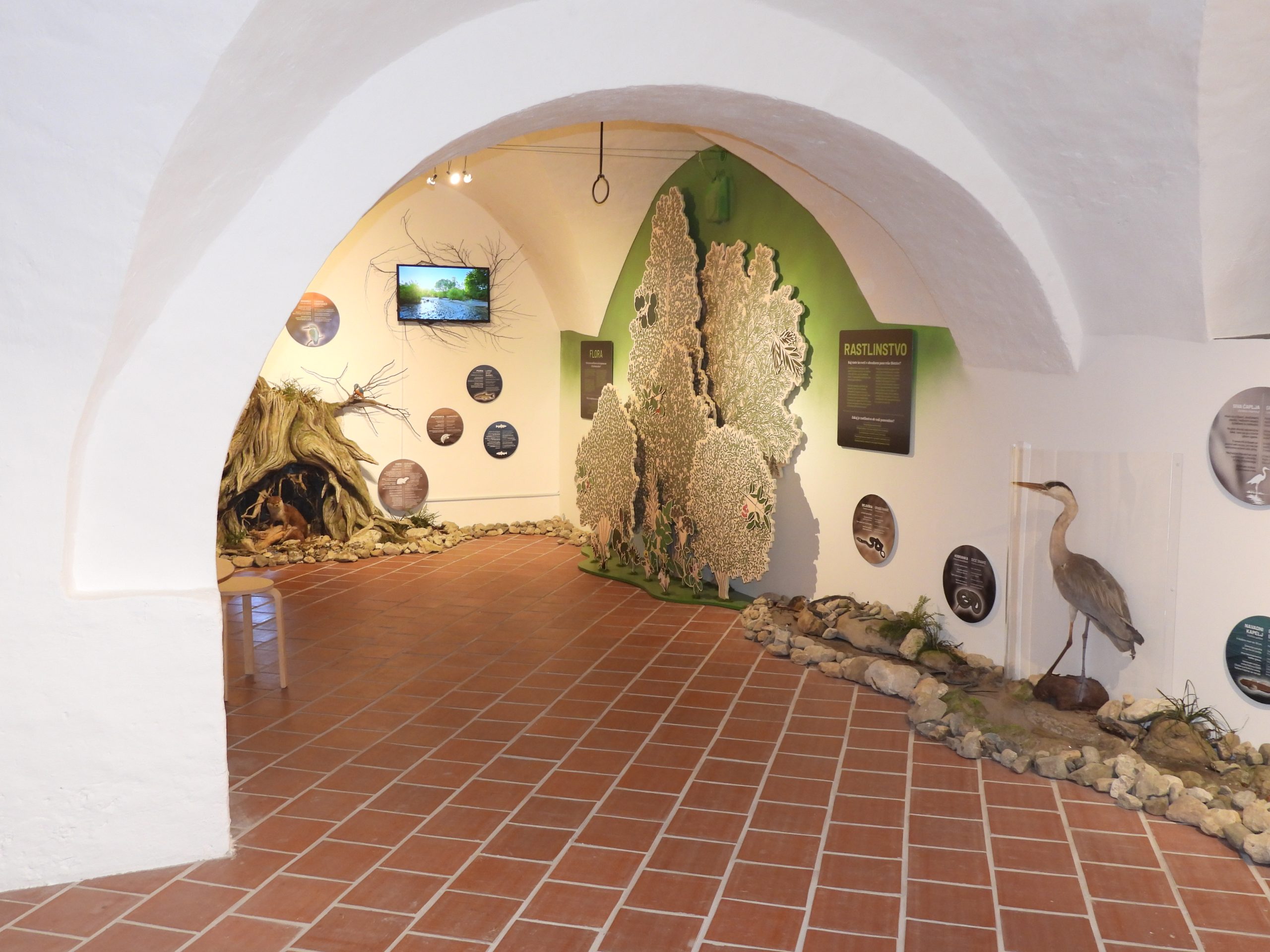
The third content section presents aquatic and riparian flora and fauna. Tree and shrub species, plants and, of course, insects, mammals, birds, fish, shellfish, crabs and snakes are presented. Habitat types are shown in the fauna and flora section. The nightlife of the river is also presented. Special effects are presented with video content.
The Bistrica River played an important role in the development of settlements in its valley and the development of crafts and agriculture. This is the theme of the fourth content section, which shows human activity, farming, crafts, and the importance of the river for tourism. Millers and organic farming are given special attention.
Within each section, there are creative corners where younger visitors in particular can learn about individual processes and events along the river through educational games.
The exhibition is presented in four rooms of the former castle granaries. The concept of the exhibition is divided into four content sections, which follow the four rooms.
The first content section presents basic information about the river, explains its name, why it is a natural treasure of national importance, why its basin is part of Nature2000 and why the entire river, from its source to its mouth, is located within the biosphere reserve.
The second content section presents geological characteristics, the upper, middle and lower reaches of the river with processes and phenomena (erosion, transport, accumulation, waterfalls, river terraces, meanders, gravel beds) are presented. The Bistrica River Gorge with its characteristics is particularly highlighted.
The third content section presents aquatic and riparian flora and fauna. Tree and shrub species, plants and, of course, insects, mammals, birds, fish, shellfish, crabs and snakes are presented. Habitat types are shown in the fauna and flora section. The nightlife of the river is also presented. Special effects are presented with video content.
The Bistrica River played an important role in the development of settlements in its valley and the development of crafts and agriculture. This is the theme of the fourth content section, which shows human activity, farming, crafts, and the importance of the river for tourism. Millers and organic farming are given special attention.
Within each section, there are creative corners where younger visitors in particular can learn about individual processes and events along the river through educational games.

Transparency Captured
Historical glass exhibition
Forest glassworks or glazing works developed in the Kozjansko region primarily where forest areas offered sufficient quantities of wood. Green and colorless glass products were produced. In addition to glass bottles for mineral water production, the Kozjansko glassworks also made glassware for storing medicines and food products, lighting, and serving and eating utensils. The collection at Podsreda Castle mainly contains glass objects from the 19th and early 20th centuries.
»When the play of a moment becomes timelessness«
A painting exhibition by France Slana
The castle's oldest part is home to a permanent exhibition of paintings by the Slovenian artist France Slana entitled "WHEN THE GAME OF A MOMENT BECOMES TIMELESS". Here, the painter, graphic artist, and illustrator France Slana, winner of the Prešeren Award, has exhibited a number of works in oil on canvas from various periods of his career. The works are dominated by landscape and marine motifs, bouquets, and a wide range of figures, and animal motifs, including roosters, fish, and cats.


Saint Emma Memorial Room
Saint Emma is considered the first Slovenian female saint. There are many legends about her life and work, one of which says that Ema was born in 983 in the nearby town of Pilštanj. She belonged to the high nobility, being related to Emperor Henry II. She married William, Count of Brež and the County of Savinja. After the tragic death of her husband and two sons, she became the owner of a vast fortune, part of which she donated to the newly founded Benedictine women's monastery in Krka in Carinthia, where she herself took refuge. In 1045, after an exemplary and virtuous life, she is said to have died in Krka, where she is buried. Podsreda Castle is one of the points on Emma's pilgrimage route, which connects places associated with the life and work of Emma of Krško.
Historical presentation of the Podsreda Castle
What is the story behind one of Slovenia's best-preserved 12th-century Romanesque fortresses?
In the former living quarters of the south palacio, which was built around 1220, the historical presentation of Podsreda Castle offers an insight into the history of the castle, its construction history and the renovation of the castle building itself.

Bats at the Podsreda Castle
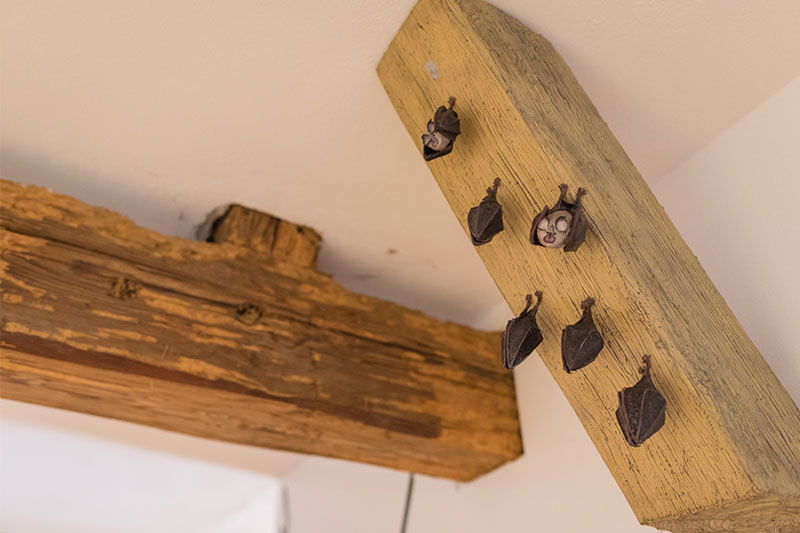
The attic of the Podsreda Castle has been chosen as a home by little fluttering creatures belonging to the bat species the lesser horseshoe bat (Rhinolophus hipposideros). The presentation of bats in the castle's attic is the last point of the Podsreda Castle Trail. The trail is located in the heart of the Kozjansko Regional Park and is a part of the Podsreda walking trail.
The Podsreda Castle Trail was created within the project "Biodiversity - the Art of Living" with the acronym LIFE Naturaviva (LIFE 16 GIE/SI/000711), in which Kozjansko Regional Park participates as a partner.
The Podsreda Castle Trail was created within the project "Biodiversity - the Art of Living" with the acronym LIFE Naturaviva (LIFE 16 GIE/SI/000711), in which Kozjansko Regional Park participates as a partner.